
Learning how to get a straight cut with a circular saw can seem tricky at first. Many people find it challenging because it requires precision and a good setup. Don’t worry, though! It’s totally achievable, even if you’re just starting. We’ll break down the process step-by-step, making it easy to understand. We’ll cover everything from getting your tools ready to making the cut, so you can start confidently on your woodworking projects. Let’s get started!
Key Takeaways
- Learn how to choose the right circular saw blade for your project.
- Discover how to use a straight edge to guide your cuts accurately.
- Understand the importance of measuring and marking your wood correctly.
- Find out how to set the depth of cut on your circular saw safely.
- Become familiar with essential safety precautions when using a circular saw.
- Gain confidence in making straight, clean cuts for all your projects.
Getting Ready for the Cut: Tools and Prep
Before you even think about making a cut, you need to gather your tools and get everything prepared. This is where it all starts. Having the right equipment and setting up your workspace correctly is half the battle. This section will help you assemble everything and make sure you have a safe and efficient setup. Think of it as building a strong foundation for a great cut. We’ll cover what you need, how to pick the right blade, and the importance of accurate measurements.
Selecting the Correct Saw Blade
Choosing the right saw blade makes a huge difference in the quality of your cut. Not every blade is made for every job. A blade designed for ripping (cutting with the grain) will perform differently than one made for crosscutting (cutting across the grain). There’s a lot of variety, from blades for wood to those for metal, so taking the time to pick the right one will save you time and prevent frustrations. This is a very important first step to a successful cut. The blade impacts the quality and the speed of your cuts.
-
- Blade Type: Choose a blade designed for the type of wood and cut you’re making. Ripping blades have fewer teeth and are for cutting with the grain, whereas crosscut blades have more teeth for cleaner cuts against the grain.
Ripping blades excel at cutting quickly along the wood grain, ideal for breaking down large pieces into smaller sections. Crosscut blades, on the other hand, are engineered for making precise cuts across the wood grain, ensuring a clean edge without splintering. These blade designs make all the difference in the finished product.
-
- Tooth Count: Blades with more teeth leave a smoother finish but cut more slowly. Blades with fewer teeth cut faster but may leave a rougher edge. A higher tooth count results in a smoother, more refined cut, which is very helpful when a pristine finish is a must.
The number of teeth on a blade directly affects the smoothness of the cut. Blades with a higher tooth count generate a cleaner edge, which is perfect for projects where a flawless finish is important. Blades with fewer teeth cut more rapidly, but may produce a rougher cut edge.
-
- Blade Diameter: Make sure the blade diameter matches your saw’s requirements. Most circular saws use blades that are 6 ½ or 7 ¼ inches in diameter. The size of the blade needs to match your saw for it to work properly.
The diameter of your saw blade must correspond to your circular saw’s specifications. Using the correct size ensures the saw operates safely and efficiently. Always refer to your saw’s manual to find the proper blade diameter. The correct blade size will let you make the perfect cut. Otherwise, you’re at risk of potential injury.
Essential Safety Gear
Safety should be your top priority when operating a circular saw. This tool can be dangerous if not used correctly. Wearing the proper safety gear will help prevent injuries and allow you to work more comfortably. Always keep safety gear close by. Getting into the habit of wearing it will keep you safe during your project. Remember, prevention is key, and taking these precautions will help you stay safe.
-
- Safety Glasses: Always wear safety glasses or a face shield to protect your eyes from flying debris. They are the most important piece of safety gear.
Safety glasses act as a barrier against flying wood chips and other particles that may get into your eyes. These objects can result in injury, so protective eyewear should always be worn while using a circular saw.
-
- Hearing Protection: Use earplugs or earmuffs to protect your hearing from the loud noise produced by the saw. The noise of a circular saw can be quite loud.
The sounds produced by a circular saw can be quite damaging to your hearing, so it’s essential to wear protection. Protect your ears, and you’ll be able to work comfortably without the risk of long-term problems.
-
- Dust Mask or Respirator: Wear a dust mask or respirator to avoid inhaling sawdust. Some woods create harmful dust that can cause breathing problems.
Wood dust may be harmful if inhaled, so wearing a dust mask or respirator is very important. This equipment helps filter out particles and keep your airways safe while you work. Using a dust mask is helpful for preventing both short-term and long-term health issues.
Setting up Your Workspace
A well-organized workspace makes a huge difference when you’re working with a circular saw. It allows you to move freely and keeps your project on track. This means having enough space to work comfortably and setting up supports for your wood. Make sure your project has plenty of space so you can cut straight and be safe. A safe workspace is essential for your success.
-
- Adequate Lighting: Ensure your workspace is well-lit so you can see your cut lines clearly. Poor lighting can result in inaccurate cuts.
Proper lighting is essential for visibility when working with a circular saw. Make sure your workplace is properly lit so you can easily see the cut lines. This helps ensure accuracy and prevents mistakes.
-
- Stable Surface: Use a workbench or sawhorses to support the wood you’re cutting. Make certain that the wood is stable so it doesn’t move during the cut.
Using a workbench or sawhorses creates a stable platform for your wood, which helps you make clean cuts. Stable support is important because it stops the wood from moving while cutting, helping with precision.
-
- Clear Area: Keep your workspace clear of clutter to avoid tripping hazards and allow for easy movement. A tidy workspace is a safe workspace.
A clean, organized area is essential for your safety and efficiency. Remove any obstructions or clutter from your work area to reduce the risk of accidents and to promote smooth operation of your circular saw.
Making the Cut: Techniques for Accuracy
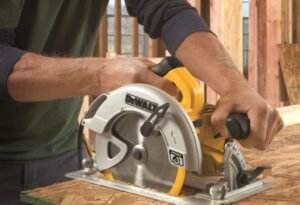
Now, let’s explore how to actually make that straight cut. This involves some simple steps. Here, we’ll cover how to mark your wood, how to use a straight edge to guide your saw, and how to control the saw for precise cuts. Learning these things will help ensure that your projects turn out as planned.
Measuring and Marking the Cut Line
Precise measurements are the foundation of any successful woodworking project. Measuring and marking your wood with care is essential. Careful marking saves time and materials because mistakes can be very costly. Let’s delve into the steps of getting an accurate mark.
-
- Accurate Measurements: Use a measuring tape or ruler to accurately measure where you want to cut. Double-check your measurements to prevent errors.
Accurate measuring is key, so make certain your measurements are correct. Double-check everything, as any mistakes made at this stage may cause big problems later. Being accurate is essential when you want to achieve the right result.
-
- Mark the Cut Line: Using a pencil or marking knife, clearly mark the cut line on your wood. Make sure it’s easy to see.
Clearly marking your cut line is an important step. Using a pencil or marking knife is the best way to do this. Make sure that the line is easy to see and that it will allow you to cut without any issues.
-
- Extend the Line: If your cut line is longer than your ruler, extend it using a straight edge to ensure a straight mark across the wood. Accurate marking will help you get the best results.
For longer cuts, use a straight edge to extend the mark across the surface of the wood. This guarantees a straight line. Correct marks are crucial for getting a perfect cut.
Using a Straight Edge for Guidance
A straight edge is a must-have tool for getting a perfectly straight cut. It helps guide the saw along the wood, making it easy to cut precisely. There are several options, from manufactured guides to using a simple board as a guide. Let’s explore how to use different types of straight edges, so you get the most accurate results.
-
- Types of Straight Edges: You can use a speed square, a level, or a dedicated edge guide. Make certain whatever you select is straight and stable.
There are multiple straight edges you can use for your circular saw. These include a speed square, a level, or a specific guide. The most important thing is that the edge is straight and will not move during the cut. This will greatly increase your chances of a perfect cut.
-
- Positioning the Guide: Place the straight edge along your cut line. Ensure it is aligned correctly before proceeding.
Place your chosen straight edge directly along the cut line that you marked earlier. Carefully align it to make sure the saw blade follows the line during the cut. Always double-check your alignment before you make a cut. If you want a straight cut, make certain that your edge is where it should be.
-
- Clamping the Guide: Secure the straight edge using clamps to prevent it from moving during the cut. This helps make accurate cuts.
Use clamps to securely fasten the straight edge in position. This step will guarantee that the guide won’t move while you cut. Secure the edge properly to allow for a straight and precise cut.
Controlling the Circular Saw
Operating a circular saw involves knowing how to hold it, how to start the cut, and how to maintain a smooth pace. Using the saw properly is essential for getting the straight cuts you want and staying safe. With a little practice, you can get the hang of it and make clean, accurate cuts. Here’s a look at how to properly operate the saw.
-
- Grip and Stance: Hold the saw firmly with both hands, keeping a good, balanced stance. This ensures stability and control.
When operating a circular saw, hold it firmly with both hands. This improves stability and provides better control over the saw, which is essential for accuracy and safety. A good grip keeps you stable and results in straight cuts.
-
- Starting the Cut: Position the saw blade just over the wood and start the saw. Allow the blade to reach full speed before beginning the cut.
Place the saw blade above the wood and then start the motor. Allow the saw blade to reach its maximum speed prior to initiating the cut. This improves cutting performance and helps prevent kickback. Giving the saw time to reach full speed will enhance the quality of your cuts.
-
- Cutting Speed and Pressure: Guide the saw at a steady pace, applying gentle, even pressure. Avoid forcing the saw through the wood. Let the blade do the work.
Guide the saw in a slow, controlled, and even manner, providing only moderate pressure. Forcing the saw can lead to an uneven cut and can also pose a safety risk. Let the saw blade perform its cutting function for better results.
Common Mistakes and Troubleshooting
Even with the best preparation, things can still go wrong. It’s helpful to know what the common mistakes are, so you can avoid them. This section will help you diagnose problems and fix them. Knowing what to watch for will save you time and materials and will increase the quality of your cuts.
Wavy Cuts and How to Fix Them
Wavy cuts are a common issue for circular saw users, which can mess up your project. This is often caused by poor technique or an improperly set-up guide. Let’s find out how to identify what goes wrong and how to fix it.
-
- Problem: The saw blade is not following a straight line. This often indicates the saw is not straight.
A wavy cut is often caused when the saw blade does not go in a straight line. This can be caused by various things, like not using a guide or applying unequal pressure.
-
- Solution: Ensure your straight edge is securely clamped. Keep the saw blade aligned with the guide. Maintain consistent pressure and speed.
Make sure your straight edge is fixed properly, and that the blade stays in line with it. Keep even pressure and go at a consistent speed to prevent the blade from moving and creating a wavy cut.
-
- Check Blade: Ensure the blade is sharp and installed correctly. If the blade is dull, it may lead to less clean cuts.
Examine the saw blade. A dull blade can produce wavy cuts. Also, make sure it is installed correctly, which can help ensure it stays in line and cuts the wood with ease.
Blade Binding and Kickback
Blade binding and kickback are serious safety concerns. Kickback can cause the saw to jump back toward the operator. It can cause serious injury. Understanding what causes these problems and how to prevent them is critical.
-
- Problem: The blade gets stuck in the wood or the wood pinches the blade, causing the saw to jump backward. This is a hazardous situation.
Blade binding occurs when the blade gets stuck in the wood, or the wood pinches the blade. This can lead to kickback, where the saw jumps towards the operator, creating a dangerous situation.
-
- Solution: Prevent binding by using the correct blade and cutting speed. Ensure the wood is supported properly.
Prevent binding by choosing the right blade for the type of wood and cutting carefully. Make certain the wood is supported so it will not pinch the blade.
-
- Safety Features: Most saws have safety features like a blade guard. Ensure the guard is in good working order.
Modern circular saws have safety features, like blade guards, to protect the operator. Make sure these are in good condition and functioning properly to reduce the chance of serious injury.
Dealing with Splintering
Splintering is when the wood tears or breaks during the cut. This ruins the look of your project and creates problems. Getting rid of splintering requires some adjustments to your technique and blade selection. Here is how to make sure your cuts stay smooth.
-
- Problem: Wood fibers tear along the cut edge, creating an imperfect finish. This may be caused by a dull blade.
Splintering occurs when the wood fibers tear along the cutting edge. This causes an imperfect look on the final product. Problems include a dull blade or an improper feed rate.
-
- Solution: Use a blade with more teeth. Cut slowly and make sure your blade is going in the right direction.
Use a blade with more teeth to get a clean, perfect cut. Slowly cut the wood, and always make sure that the blade is going in the right direction.
-
- Cutting Direction: Cut with the good face up to make sure any splintering happens on the unseen side. This prevents an imperfect look.
When cutting, place the good side of the wood facing up. If splintering happens, it will be on the bottom, where it is not seen. This helps you get a better-looking end result.
Advanced Techniques for Precision
Once you are comfortable with the basic techniques, you can move on to more advanced methods for getting perfect cuts. These techniques will help you handle various materials and cutting scenarios. This part focuses on the specific things that will help you enhance the accuracy of your work. These techniques will take your projects to the next level.
Using a Track Saw System
Track saw systems are a perfect choice for achieving incredibly accurate cuts, especially on larger pieces. They combine a saw with a guide track. This system is a great way to ensure clean, precise cuts. It is an amazing addition to a woodworker’s tools.
-
- How It Works: The saw slides along a track that is clamped to the wood, ensuring a straight cut every time. The track is the key.
A track saw system has a saw that slides along a track attached to the wood. This guarantees that your cuts are straight every time. The track guides the saw to produce very accurate cuts.
-
- Benefits: Provides unparalleled accuracy. Great for cutting sheet goods and large pieces. You can cut long pieces safely and accurately.
Track saw systems are famous for their unmatched precision, especially when working on big sheets of wood. They are great for cutting large workpieces safely, which produces great results.
-
- Investment: Track saws are a bit of an investment, but they provide great accuracy for serious woodworking tasks. They are very helpful for getting the results you need.
Track saw systems come at a higher cost, but they are very helpful when you want more precision. If you do lots of woodworking, it may be a worthwhile investment.
Making Bevel Cuts
Bevel cuts are angled cuts. They are essential for creating joints and complex designs. These cuts can add to the look of your projects. Understanding how to make these cuts properly is essential to your success.
-
- Setting the Angle: Adjust the saw base to the desired angle using the bevel adjustment. Check the bevel angle carefully.
Set the bevel angle by using the adjustment on the circular saw. Precisely adjust the angle using the indicator on your saw. Always double-check your adjustment.
-
- Cutting: Place the wood at the proper angle and make the cut. Make certain the saw blade is set.
Position the wood carefully to ensure the saw blade is properly aligned. Then, execute the cut smoothly, keeping an even pace. Accuracy is key when doing bevel cuts.
-
- Safety: Be extra cautious. The angle affects the blade’s position, increasing the risk of kickback. Use a good grip.
Be extra careful when making bevel cuts because the angle changes the position of the blade. This can raise the possibility of kickback. Always be aware of your stance and hold on tight.
Cutting Compound Angles
Compound angles involve both a bevel and a miter cut. They are important for more complex projects. These cuts can enhance the appearance of your work. It’s a great skill to have.
-
- Understanding: A combination of a bevel (angle) and a miter (angle) cut. They are found in projects that need corners.
Compound angles are when you combine a bevel cut with a miter cut, which results in a combined angle. These cuts are often used to create corners in different types of woodworking projects.
-
- Setting: Set both the bevel and miter angles on the saw. Do a test cut on scrap.
To cut compound angles, you must set both the bevel and the miter angles on your saw. A test cut helps you make sure everything is properly aligned.
-
- Practice: Practice on scrap wood to fine-tune your settings before cutting your actual pieces. Accuracy here is crucial.
Practice on scrap wood so you can test your settings prior to cutting your project. This will help you get the best results.
Frequently Asked Questions
Question: What’s the best way to prevent the wood from moving while cutting?
Answer: Clamp the wood securely to a workbench or use sawhorses. The wood needs to be stable so the cut is straight.
Question: How do I know which saw blade to use for my project?
Answer: Choose a blade based on the material and the type of cut. Ripping blades are for cutting with the grain, and crosscut blades are for cutting across the grain.
Question: What do I do if my circular saw is causing kickback?
Answer: Stop immediately. Check for blade binding, uneven feeding, or too much force. Ensure your blade is sharp.
Question: How can I achieve clean cuts without splintering?
Answer: Use a blade with a higher tooth count. Cut slowly, ensuring the blade is sharp and installed correctly. Consider using a scoring cut.
Question: What are the main advantages of using a track saw system?
Answer: Track saws provide extremely accurate cuts. They are helpful for cutting large sheets, giving you more flexibility.
Final Thoughts
Achieving a straight cut with a circular saw is all about precision, preparation, and safety. You learned how to select the right blade, prepare your workspace, and use techniques like straight edges to guide your saw. You also explored how to deal with common problems like wavy cuts and blade binding. Remember, the more you practice, the better you’ll become at making clean, accurate cuts. Don’t be afraid to try different techniques. Each project you complete will increase your skills and confidence. Embrace the learning process, and soon you’ll be creating straight cuts with ease. Happy cutting, and enjoy your woodworking adventures!

I’m John F. Nicholas, the founder, lead writer, and drill enthusiast behind 101drill.com. With years of hands-on experience in power tools and DIY projects, I created this platform to share practical knowledge, expert tips, and real-world insights to help others master the art of drilling.