
Learning how to cut straight with a circular saw is a common challenge for anyone starting woodworking or DIY projects. It seems simple, but getting those perfect, clean lines can be tricky. Don’t worry, many people struggle at first. This guide will walk you through the process step-by-step, making it easy to achieve accurate cuts every time. We’ll cover everything from the basic setup to the finishing touches. Let’s explore how to get started!
Key Takeaways
- Learn the essential safety steps before using a circular saw.
- Discover the best tools and accessories to help you cut straight.
- Understand how to measure, mark, and prepare your wood for cutting.
- Master the techniques for making accurate, clean cuts.
- Explore how to troubleshoot common cutting problems.
- Gain confidence in your ability to cut straight with a circular saw.
Getting Started: Safety and Your Circular Saw
Before you even think about making a cut, safety is the most important thing. This is non-negotiable. Using a circular saw involves a spinning blade that can cause serious injury if not handled properly. This section covers all the essential safety procedures and familiarizes you with the parts of your saw. We’ll also explore the types of circular saws and which are best for your needs. Always remember that safety glasses and hearing protection are a must.
Safety First: Protect Yourself
-
- Always Wear Safety Glasses: Flying debris is a real danger.
Safety glasses are a must-have when using a circular saw. Wood chips, sawdust, and even small pieces of the material can be thrown towards your face at high speed by the spinning blade. Even a small piece of wood in your eye can be incredibly painful and potentially lead to serious injury. Make sure your safety glasses fit well and provide good coverage, including the sides of your eyes. Consider using glasses with anti-fog properties for added convenience. Proper eye protection is non-negotiable for anyone using a circular saw.
-
- Use Hearing Protection: Loud noises can cause damage.
Circular saws can be incredibly loud. The noise can easily exceed safe levels for your ears, and prolonged exposure can lead to hearing loss or other related issues. Simple earplugs or earmuffs can significantly reduce the sound exposure. The type of hearing protection you choose depends on your preference and the intensity of the noise. Earplugs are often more portable, but earmuffs can provide a higher level of protection, particularly if you use your saw often. Protect your hearing; it’s vital for your health and well-being.
-
- Wear a Dust Mask: Protect your lungs from sawdust.
When you cut wood, you create a lot of sawdust. Breathing in sawdust, especially over time, can irritate your respiratory system, and even cause more serious health issues. A dust mask is a very basic but effective layer of protection. It filters the air you breathe, catching most of the harmful particles before they can enter your lungs. For more heavy-duty use, consider a respirator, which provides a higher level of filtration. Regularly replace your dust mask to maintain its effectiveness. Prioritize your lung health; it’s essential for a good woodworking experience.
-
- Use a Properly Functioning Saw: Ensure your saw is in good working order.
Before you even plug in your saw, give it a quick check. Look for any damage to the cord, such as cuts or fraying. Examine the blade to make sure it’s secure and in good condition, and that it isn’t cracked, bent, or showing excessive wear. Make sure the blade guard moves freely and covers the blade properly. Test the saw’s on/off switch to ensure it functions correctly. Never use a saw if you notice any electrical issues. A well-maintained saw is a safe saw. Properly maintaining your saw ensures that it is in good working order.
Understanding Your Circular Saw
-
- Types of Circular Saws: Know your options.
There are generally two main types of circular saws: corded and cordless. Corded saws are plugged into a power outlet and provide a continuous source of power, making them ideal for long projects. Cordless saws run on batteries, offering greater mobility and freedom from cords, but they have a limited run time. The choice between the two depends on your specific needs and the type of projects you are working on. Consider the length of your cutting sessions and the availability of power outlets when making your decision. Both types have their advantages, so choose the one that works best for you.
-
- Parts of a Circular Saw: Get to know your tool.
Understanding the parts of your circular saw is key for safe and effective use. Familiarize yourself with the blade guard (covers the blade), the baseplate (rests on the wood), the shoe (provides stability), the bevel adjustment (allows angled cuts), and the depth adjustment (controls the cutting depth). The handle provides a firm grip and control. The on/off switch powers the saw. The blade is the cutting element. Knowing each part and how it works allows you to make precise and controlled cuts. Knowing your saw means having control. This boosts your safety and accuracy when you’re working.
-
- Choosing the Right Blade: Pick the perfect blade.
The type of blade you use makes a big difference in the quality of your cuts. Blades come in various types, designed for different materials and cut types. Consider the wood you are cutting. A crosscut blade is best for cutting across the grain, leaving a cleaner edge. A rip blade is designed for cutting with the grain. Combination blades can do both. The number of teeth on the blade also matters: more teeth produce smoother cuts but are slower, while fewer teeth cut faster but may leave a rougher edge. The right blade for the job will help you get better results.
Tools and Accessories for Cutting Straight
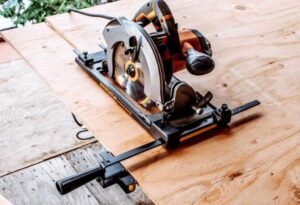
While a circular saw is the main tool for the job, other tools and accessories can help you cut straight and safely. This includes items to help you measure, mark, and guide your saw. Getting the right tools will make your woodworking projects much easier. This section will explore the essentials, from pencils and squares to clamps and guides. Knowing the right tools makes all the difference when getting a clean, straight cut. Using these tools will help you achieve the best results.
Essential Measuring and Marking Tools
-
- Tape Measure: Accurate measurements are crucial.
A good tape measure is your best friend when it comes to any woodworking project. It allows you to measure your wood accurately. Make sure your tape measure is easy to read. Many have both inch and centimeter markings. A tape measure with a lock mechanism is essential, helping you hold your measurement in place. Know how to properly read and use your tape measure. Measuring twice and cutting once can save you from costly mistakes. A quality tape measure is fundamental to a project’s success.
-
- Pencils and Marking Knives: Precision is key.
Choose a pencil with a fine point to make clear and precise markings. A mechanical pencil is a good option. A marking knife can be useful if you’re working with hardwoods or want to create a slightly deeper line for the saw to follow. Keep your pencils sharp. Place your mark accurately and double-check it. Accurate markings guide your cuts, ensuring that they are where you want them to be. Marking tools make for a better project, allowing you to follow your measurements.
-
- Squares: Ensuring Right Angles.
A square is a tool used to ensure that angles are perfect. Using a square when marking your wood will help you ensure that the cuts you make are square, and that your pieces fit together correctly. A combination square is a versatile tool that can be used to mark 45 and 90-degree angles. A speed square (also called a rafter square) is another good choice, especially for making quick measurements and angles. Using a square is critical for any woodworking project that requires precise angles.
Guides and Clamps for Cutting Accuracy
-
- Straight Edge Guide: Make sure your cuts are straight.
A straight edge is a simple but effective tool for guiding your saw along a straight line. You can use a long level, a piece of straight lumber, or a manufactured edge guide. Place the straight edge along your cut line, and then clamp it securely to your wood. Then, line up the edge of your circular saw’s baseplate with the straight edge. This helps you guide the saw along the straight line. Using a straight edge can dramatically improve the accuracy of your cuts, even if you are a beginner. This ensures your cuts are as straight as possible.
-
- Clamps: Secure your workpiece.
Clamps are used to hold your wood firmly in place while you are cutting. There are many different types of clamps, including C-clamps, bar clamps, and spring clamps. Choose clamps that are appropriate for the size and shape of your workpiece. Clamps prevent the wood from shifting during the cutting process. Securing your wood is essential for safety and accuracy. Always make sure your clamps are tight enough to hold the wood securely, and that your workpiece will not move. Clamping also keeps your work surface steady.
-
- Circular Saw Track System: For Professional Results.
A circular saw track system is a more advanced tool that can help you achieve very precise and straight cuts. It consists of a track that you attach to your workpiece, and a base that attaches to your circular saw. The saw then slides along the track, ensuring that the blade cuts in a straight line. Track systems are especially useful for cutting large sheets of plywood or other materials where precision is essential. These systems take a bit of practice to use, but they can significantly improve your results. They are a great way to improve your projects, and they will help you achieve a polished look.
How to Measure, Mark, and Prepare for Cutting Straight
Before you even turn on your saw, you need to prepare your wood. This involves measuring and marking your cut lines. Taking the time to do this correctly is critical for achieving accurate results. This section will explore the correct techniques for measuring, marking, and setting up your workspace. Precision here will directly affect the accuracy of your cuts. Doing it right can also ensure you’re safe, resulting in quality work.
Measuring and Marking Your Cut Lines
-
- Accurate Measuring: Double-check everything.
Carefully measure the length of your cut. Use your tape measure, and make sure to read the markings accurately. Remember to take into account the blade’s kerf (the width of the cut). For a standard circular saw blade, the kerf is around 1/8 inch. If you are cutting a piece to a specific length, subtract the kerf from the total measurement. It’s always a good idea to measure twice and cut once. This can save you a lot of wasted time and materials. Always double-check your measurements to avoid costly errors. Accuracy pays off when building any project.
-
- Marking Your Cut Lines: Fine-point precision.
Use a pencil with a sharp, fine point to mark your cut lines. A mechanical pencil is a great option. Make sure your lines are clear, and easy to see, but not so thick that they will mislead you. Use your square to ensure that your cut lines are perfectly straight. Consider marking the cut line on both sides of the wood, especially for thicker pieces. This will help you keep the saw blade aligned as you cut. Clear and precise markings are essential for accurate cutting. A quality line will allow you to work with precision.
-
- Using the Kerf: Account for the blade’s width.
The kerf is the width of the cut that your saw blade will make. This is important to consider when measuring and marking your cut lines. For example, if you want to cut a piece of wood exactly 12 inches long, and the blade has a kerf of 1/8 inch, you will need to cut along the inside of your 12-inch mark. This ensures that the final piece will be the correct length. It is also important to take the kerf into account when making cuts that will fit together. You can always practice on some scrap pieces to see how it works. Knowing the kerf gives you control over the final product.
Preparing Your Workpiece for Cutting
-
- Supporting Your Wood: Preventing movement.
Make sure your workpiece is well supported. Use sawhorses or a workbench to provide a stable surface for your wood. For larger pieces, you may need to use multiple supports. This is not only for safety, but also for accuracy. If your wood is unstable, it could move during the cutting process, leading to inaccurate cuts. If you’re cutting a long piece, make sure to support the entire length of the wood. Make sure your work surface is stable and sturdy. Good support prevents mistakes.
-
- Using Clamps: Securing the workpiece.
Clamping your wood to your workbench or sawhorses is essential for keeping it still during the cut. Choose clamps that are appropriate for the size and shape of your workpiece. Position your clamps so that they hold the wood securely, without interfering with the path of the saw. Make sure the clamps are tight enough to hold the wood in place, but not so tight that they damage it. Securing your wood with clamps helps avoid mistakes. Clamping is an essential step for safety and precision.
-
- Positioning Your Workpiece: Cutting direction matters.
Consider the direction of the wood grain when positioning your workpiece. Cutting with the grain (ripping) is generally easier and produces a smoother finish. When cutting across the grain (crosscutting), you may get some splintering on the back side of the cut. To minimize this, you can put the good side down. With the good side down, the saw will cut through the top of the wood first, reducing splintering on the visible surface. Take a moment to think about grain direction before starting your cuts. Correct positioning leads to better results.
Cutting Straight With a Circular Saw: Techniques
Now that you’ve prepared your wood and your workspace, it’s time to make your cuts. The right technique is essential for achieving straight, clean cuts. This section will walk you through the proper cutting procedure, including how to position your saw, control your cut, and avoid common mistakes. Proper technique is the foundation of accuracy and safe sawing. Taking the time to learn and practice these techniques will greatly improve your results. This will ensure you create pieces that are straight and exactly what you need.
Holding and Positioning the Saw
-
- Grip and Control: How to hold the saw properly.
Hold the saw firmly with both hands, one on the handle and the other on the front of the saw (typically a second handle or a place to grip). Make sure your grip is secure but relaxed, so that you maintain control of the saw without tiring yourself. Your grip on the saw is critical for safety and control. Ensure your fingers are clear of the blade and other moving parts. Hold the saw with a firm grip but relaxed. Firm, but not tense, lets you maintain control during your cuts.
-
- Positioning the Saw Blade: Aligning with the cut line.
Carefully align the saw blade with your marked cut line. Use the edge of the saw’s baseplate as your guide. Make sure the blade is exactly where you want it. This is where your markings come in handy. It’s often helpful to look at the blade from above, so you can see if the blade is properly aligned. Double-check your alignment before you start cutting. Make any necessary adjustments. Proper alignment is key to an accurate cut. Alignment is key, so make sure to double-check this step.
-
- Stance and Posture: Maintain balance and control.
Stand in a comfortable position, with your feet shoulder-width apart. This gives you a stable base. Keep your body relaxed, and avoid leaning too far forward or to the side. Make sure you can see the cut line clearly. Keep your weight balanced, so you can control the saw throughout the cut. A good stance and posture will improve your balance and control. These fundamentals are key for a safe and accurate cut. Being stable makes you safer and helps with precision.
Making the Cut
-
- Starting the Cut: Control the saw from the beginning.
Before you start cutting, ensure the blade is not touching the wood. Turn on the saw and let the blade reach its full speed. Slowly lower the blade into the wood, keeping the baseplate flat against the surface. Start the cut smoothly, and keep the saw moving forward at a steady pace. Keep the saw moving forward steadily at a good pace. Avoid pushing too hard, as this can cause the blade to bind or kickback. A smooth start sets the tone for a good cut. Control is key during the process.
-
- Guiding the Saw: Keeping it on the line.
Follow your marked cut line carefully, keeping the baseplate of the saw firmly against the wood. Use a straight edge guide if needed, for extra accuracy. Watch the blade as it cuts to make sure it’s on the line. If you start to drift off the line, stop the saw immediately and adjust. Don’t force the cut; let the saw do the work. Guiding the saw is critical for a straight cut. Slow and steady wins the race. Keep the saw moving smoothly.
-
- Finishing the Cut: Staying in control to the end.
As you near the end of the cut, maintain control of the saw and continue to guide it along the cut line. Don’t rush the process, and stay focused. Be aware that the piece you are cutting may start to separate, especially if it’s long or thin. When the cut is complete, turn off the saw and let the blade come to a complete stop before removing it from the wood. Finishing the cut safely is very important. Always be sure to keep control to the end.
Troubleshooting Common Cutting Problems
-
- Blade Binding: What to do if the blade gets stuck.
If the blade binds in the wood, turn off the saw immediately and release the trigger. Do not try to force the saw out of the cut. A jammed saw can kick back, causing injury. Once the blade has stopped, carefully remove the saw from the wood. Check your blade, and make sure it is aligned properly and that the wood is not pinching it. Blade binding can happen if the blade is not sharp enough, or if the wood is warped or uneven. Safety first: stop the saw immediately. Take your time to fix the issue and prevent injury.
-
- Kickback: Avoiding and responding to it.
Kickback happens when the wood pinches the blade, causing the saw to be thrown back towards you. To avoid kickback, always keep the baseplate of the saw flat against the wood, and use a sharp blade. Never force the saw through the cut. If kickback occurs, keep a firm grip on the saw, and try to maintain control. It’s better to have a slow and steady pace to avoid this. Kickback can be very dangerous, so it’s important to take precautions to prevent it. Always be aware of the possibility, and react safely.
-
- Wavy Cuts: Fixing unevenness.
If your cuts are not straight, one likely cause is that you are not guiding the saw in a straight line. Make sure you are using a straight edge or guide. Examine your blade to see if it’s damaged or dull. Make sure your baseplate is flat against the wood. You may be pushing the saw too hard. Go slower. Sometimes, the wood grain can cause the blade to wander, but a steady hand and a good guide should correct it. Don’t give up if your cuts aren’t perfect at first. With practice, you can improve your technique. Work methodically to improve your skills.
Frequently Asked Questions
Question: What’s the best way to ensure I cut a perfect 90-degree angle?
Answer: Use a square to mark your cut line, and make sure the saw blade is perfectly aligned with the line and perpendicular to the wood surface.
Question: How can I prevent the wood from splintering when crosscutting?
Answer: Place the “good” side of the wood face down, or use a blade designed for crosscutting, which will help make a cleaner cut.
Question: What kind of circular saw is best for beginners?
Answer: A corded circular saw is often a good starting point because it offers continuous power, but a cordless saw provides mobility.
Question: How do I maintain my circular saw blade to ensure straight cuts?
Answer: Keep your blades sharp and clean. Inspect them regularly for damage. Replace blades as soon as they dull.
Question: Where can I practice cutting straight with a circular saw safely?
Answer: Start with scrap wood and practice making straight cuts on the scrap material before working on your actual project.
Final Thoughts
Mastering how to cut straight with a circular saw can feel challenging at first. But by following the steps outlined in this guide, you can improve your accuracy, and build confidence with this essential tool. Remember that safety is your top priority. Always wear protective gear and double-check your setup before making a cut. With the right tools, careful measuring, and a steady hand, you can make precise cuts every time. Keep practicing, and don’t be discouraged by mistakes. Every cut is a learning experience. With each project, your skills will grow. You’ll soon be tackling more complex projects with confidence. So, gather your materials, follow the steps, and start cutting straight. You got this!

I’m John F. Nicholas, the founder, lead writer, and drill enthusiast behind 101drill.com. With years of hands-on experience in power tools and DIY projects, I created this platform to share practical knowledge, expert tips, and real-world insights to help others master the art of drilling.