
Picture a metalworker perched on a bridge beam, balancing tools while trying to drill a perfect hole through solid steel. A regular hand drill slips, vibrates, and overheats—but a magnetic drill machine stays steady, precise, and powerful. These compact yet robust machines are built to tackle heavy-duty drilling in places where traditional equipment fails.
A magnetic drill—often called a mag drill—uses a magnetic base to cling firmly to ferrous metal surfaces. This strong magnetic hold allows accurate drilling even on vertical, overhead, or curved surfaces. The technology behind it makes the process safer, faster, and more consistent, which is why industries like construction, shipbuilding, and manufacturing rely on it daily.
According to trade research, more than 70 % of fabrication workshops worldwide employ magnetic drills for on-site precision drilling. Their ability to combine portability with industrial-grade strength makes them indispensable in modern engineering.
In this comprehensive guide, we’ll explore how magnetic drills work, their components, types, advantages, and practical uses—plus key maintenance and safety insights every operator should know.
What Is a Magnetic Drill Machine?
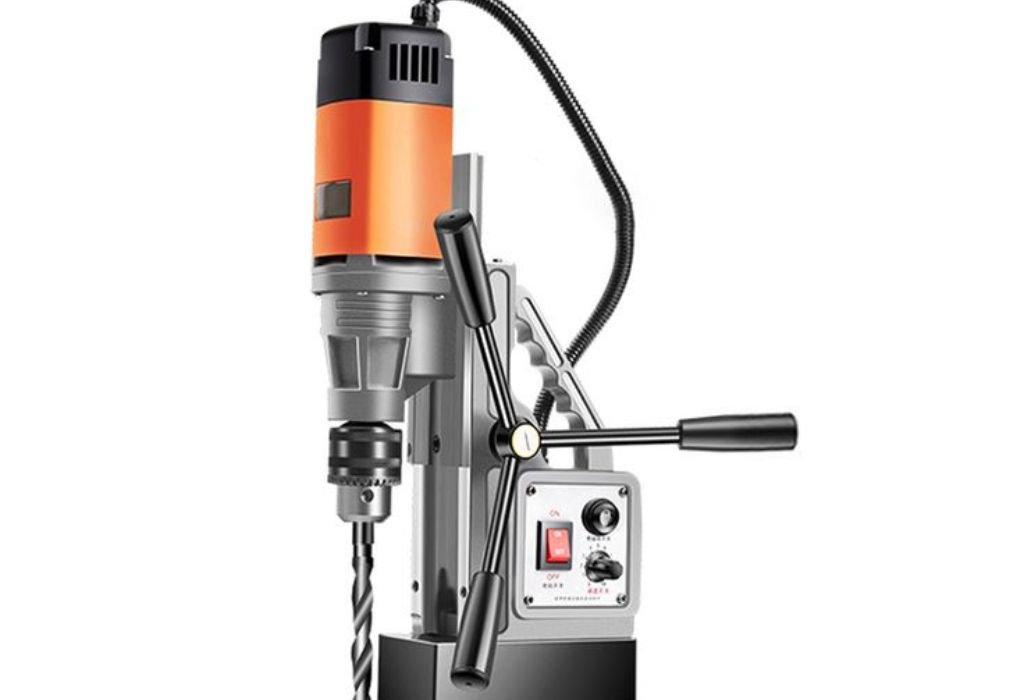
A magnetic drill machine is a portable power tool designed to drill holes in ferrous metals using a powerful magnetic base for stability. When placed on a steel surface, the magnet—either electromagnetic or permanent—locks the drill in place, allowing accurate drilling without movement or vibration.
Unlike conventional hand drills or stationary drill presses, a mag drill is engineered for fieldwork. It can operate on beams, columns, and metal structures that cannot be moved to a workshop. Its main components include a motor, spindle, magnetic base, feed handles, and an arbor to hold the drill bit or annular cutter.
Magnetic drills are commonly used to create holes for bolts, rivets, or fasteners in heavy-gauge steel. Their precision allows contractors and fabricators to maintain tolerances within millimeters, which is critical in construction and mechanical assembly. The magnetic base eliminates the instability of handheld tools and reduces operator fatigue by doing most of the stabilizing work automatically.
In short, a magnetic drill transforms difficult metal drilling jobs into quick, controlled operations with higher accuracy and reduced effort.
What materials can a magnetic drill work on?
Primarily ferrous metals like carbon steel, cast iron, and iron alloys.
Can it work on aluminum or stainless steel?
Only magnetic grades of stainless steel or when using a mechanical clamp base.
Is it portable?
Yes, it’s lightweight enough for fieldwork yet powerful enough for thick steel.
Does it require constant power?
Electromagnetic models do; permanent-magnet units don’t.
How thick can it drill?
Typically up to 2 in (50 mm) deep depending on cutter size.
Is setup complicated?
No—simply place, activate magnet, align, and drill.
Where is it most useful?
In construction, fabrication, heavy-equipment repair, and maintenance work.
How Does a Magnetic Drill Work?
At its core, a magnetic drill works through magnetic adhesion and rotational force. When the magnet at the base is activated, it generates enough holding power—sometimes over 1,000 kgf—to keep the drill fixed to a metal surface. This magnetic grip allows the operator to drill precise holes without slippage or vibration.
The process begins by positioning the drill on a clean, flat metal surface. The magnet is switched on, anchoring the unit. Once secured, the motor drives the cutter—usually an annular cutter or twist drill bit—at high speed while the operator controls feed pressure with handles. A coolant system circulates lubricating fluid to minimize heat and prolong bit life.
As the drill penetrates the metal, metal chips are expelled through side vents or ejected by pilot pins. The magnetic base ensures the machine stays stable even when drilling overhead or horizontally.
Some advanced drills include variable-speed motors, automatic feed controls, and LED indicators for optimal drilling conditions. Pneumatic and battery-powered models operate similarly but use compressed air or battery current instead of electricity.
Can a magnetic drill operate upside down?
Yes—when the magnet’s holding force and safety chain are secure.
What happens if the magnet fails?
A safety strap prevents the unit from falling; always use one.
Is coolant mandatory?
Yes, it reduces friction and extends cutter life.
Can the drill damage thin metal?
Use a lower feed rate or backing plate to avoid distortion.
Are all magnets electric?
No, some permanent magnets need no electricity.
Does vibration affect accuracy?
Minimal vibration ensures clean, round holes.
Can it be used on painted steel?
Remove paint or rust first for maximum magnetic contact.
Types of Magnetic Drills
Magnetic drills come in several configurations, each optimized for different work conditions:
- Electric Magnetic Drills – The most common type, powered by AC current. They offer reliable performance for workshops and on-site tasks.
- Pneumatic Magnetic Drills – Driven by compressed air; ideal in environments where electric sparks pose explosion risks (like oil refineries).
- Hydraulic Magnetic Drills – Extremely powerful, suited for heavy-duty industrial or offshore operations.
- Battery-Powered Magnetic Drills – Cordless versions offering mobility for remote work locations.
Each type has trade-offs between power, portability, and cost. Electric models deliver consistent torque; pneumatic ones ensure safety in volatile areas; hydraulic units excel in extreme workloads; and battery models provide unmatched flexibility.
Modern innovations include automatic feed systems, digital torque settings, and lightweight frames built from composite alloys. Selecting the right type depends on factors such as job site accessibility, power availability, and material thickness.
Which type is best for everyday fabrication?
Electric magnetic drills are the standard choice.
Do cordless drills match the power of wired ones?
High-capacity lithium batteries now deliver similar torque for moderate workloads.
Are pneumatic drills explosion-proof?
Yes, they are designed for hazardous environments.
Why choose hydraulic models?
For maximum torque in large-scale industrial projects.
How long does a battery mag drill run?
Typically 60–90 minutes on a full charge.
Can different types share cutters?
Yes, most use standard ¾ in Weldon shanks.
Which type is most affordable?
Electric units usually offer the best cost-to-performance ratio.
Choosing the Right Magnetic Drill for Your Needs
When selecting a magnetic drill, the choice depends on your project size, metal thickness, and drilling environment. Start by assessing how frequently you’ll use the tool — occasional users can rely on compact electric models, while professionals may need high-torque hydraulic or industrial-grade drills.
Pay attention to motor power, magnet strength, and speed control options. A higher wattage motor (typically 1,200–1,800 W) handles thicker steel, while variable speed helps manage different materials and cutter sizes. Ensure the magnetic adhesion force is at least twice the tool’s weight for vertical or overhead work.
Other key features include automatic feed, coolant systems, and digital load indicators that prevent motor strain. For remote worksites, consider battery-powered units with lithium cells that can last up to 90 minutes per charge.
Lastly, factor in after-sales support — reliable brands provide spare parts, service centers, and safety certifications. Choosing the right drill not only increases productivity but also extends the lifespan of your cutters and equipment.
How do I know what size drill to buy?
Match the cutter diameter and material thickness with your project.
Are variable-speed drills better?
Yes, they offer more control and cleaner cuts.
What magnet strength is ideal?
At least double the tool’s own weight.
Do brands matter?
Yes, reputable brands ensure safety and durability.
Can I upgrade later?
Yes, modular mag drills allow accessory changes.
What if I only drill occasionally?
Choose a lightweight electric or cordless model.
Are cheap models reliable?
They work for light use but lack industrial durability.
Key Components of a Magnetic Drill
Understanding each part helps operators maintain performance and safety.
- Magnetic Base: The heart of the tool, generating holding power through electromagnetic coils or permanent magnets.
- Motor: Converts electrical or pneumatic energy into rotational motion.
- Gearbox: Regulates torque and speed.
- Feed Handles: Allow manual control of downward drilling pressure.
- Arbor and Cutter Holder: Secure the annular cutter or twist bit.
- Coolant System: Delivers lubrication to the cutting zone.
- Safety Chain: Prevents accidents during power loss.
- Control Panel: Includes magnet switch, motor control, and overload protection indicators.
Every component plays a role in achieving clean, accurate holes. Regular inspection of these parts ensures consistent performance.
What part provides stability?
The magnetic base anchors the entire unit.
Why is the coolant system critical?
It dissipates heat and improves cutter lifespan.
Can I adjust drilling speed?
Yes—via gear selection or electronic speed control.
How often should the magnet be cleaned?
After each use; debris can reduce adhesion.
Is the safety chain optional?
No, it’s mandatory for overhead or vertical drilling.
What causes motor overheating?
Over-pressure or lack of coolant.
Can parts be replaced easily?
Yes, most reputable brands sell modular components.
Major Benefits of Using a Magnetic Drill Machine
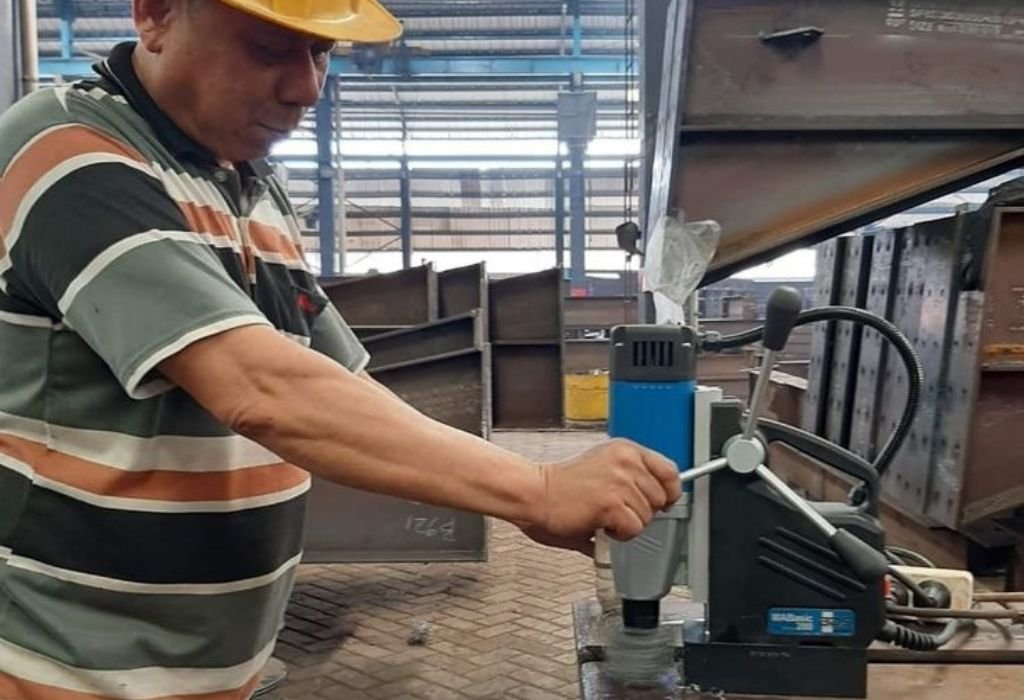
The magnetic drill offers a combination of speed, precision, and flexibility unmatched by other drilling methods.
1. Precision and Accuracy:
Its fixed magnetic base eliminates wobble, delivering clean, consistent holes—crucial in structural fabrication and bolting applications.
2. Portability:
Weighing 20–40 lbs, it’s light enough to move across job sites yet powerful for industrial-grade tasks.
3. Time Efficiency:
Annular cutters remove only the metal ring, not the whole core, reducing drilling time by up to 50 %.
4. Multi-Position Capability:
Operates seamlessly on vertical, horizontal, or inverted surfaces, expanding application possibilities.
5. Safety and Reliability:
Less manual strain and built-in safety locks reduce injury risks.
6. Longevity:
Durable construction ensures years of service under demanding conditions.
Collectively, these advantages make magnetic drills indispensable in professional metalwork.
Why do professionals prefer magnetic drills?
They combine high accuracy with portability.
Can it handle repetitive production tasks?
Yes, with minimal bit wear and consistent results.
Does it improve workplace safety?
Yes—less vibration and secure mounting minimize hazards.
Is maintenance costly?
No, regular cleaning and lubrication keep costs low.
Do magnetic drills reduce waste?
Yes, precise holes mean fewer rejected parts.
Are they suitable for DIY users?
Smaller models are great for hobbyists and repair technicians.
How long do they last?
With care, 5–10 years or more.
Common Applications in Industry
Magnetic drills are widely used across multiple sectors where steel drilling is essential.
Construction and Bridgework:
Used to drill I-beams, columns, and girders on-site, saving time otherwise spent transporting materials to workshops.
Shipbuilding and Offshore Maintenance:
Essential for hull and deck fabrication, where precision and speed prevent structural weakness.
Railway Maintenance:
Technicians use mag drills to bore holes in rail tracks during repairs.
Manufacturing and Fabrication:
Ideal for equipment assembly, heavy-machine maintenance, and production lines requiring accurate bolt holes.
Wind-Energy and Tower Installation:
Used at heights for attaching steel frames and brackets safely.
Because of their portability, mag drills allow engineers to work efficiently even in confined or vertical spaces.
Are magnetic drills used outdoors?
Yes, provided electrical protection and weather covers are applied.
Can they drill curved surfaces?
Yes, with adjustable magnetic bases or clamps.
Do shipyards rely on them heavily?
Absolutely—they’re critical in marine metalwork.
Are they useful in renewable-energy projects?
Yes, for wind-tower and solar-frame assembly.
Can a single unit serve multiple industries?
Yes, simply switch cutters for different metals.
Are they effective for maintenance crews?
Perfect for emergency or on-the-spot repairs.
Do small workshops benefit too?
Yes—compact models handle bench work efficiently.
Magnetic Drill vs Drill Press
Although both tools drill holes, they differ in design and purpose.
| Feature | Magnetic Drill | Drill Press |
| Portability | Lightweight, mobile | Stationary |
| Mounting | Magnetic base | Bolted to table |
| Work Material | Steel, iron | Wood, light metals |
| Orientation | Any angle | Vertical only |
| Ideal Use | On-site heavy drilling | Workshop fabrication |
A magnetic drill shines in portability and flexibility, while a drill press excels in repetitive bench tasks. Professionals often use both—presses for precision shop work and mag drills for field installations.
Can a magnetic drill replace a press entirely?
For metalwork, yes; for wood, a press is better.
Which offers greater precision?
Both are accurate, but mag drills hold better on vertical surfaces.
Which is safer?
Mag drills with chains and magnets are safer for fieldwork.
Can drill-press bits fit mag drills?
Some can, depending on arbor design.
Which is easier to transport?
Mag drills are compact and portable.
Do both need maintenance?
Yes—regular lubrication and alignment checks.
Which is more expensive?
High-end mag drills cost more but offer mobility benefits.
Safety Tips for Using Magnetic Drills
Safety is paramount when working with magnetic drills on site.
- Use Safety Chains: Always secure the machine before drilling vertically or overhead.
- Inspect Surfaces: Ensure the metal is clean, flat, and rust-free for maximum magnetic adhesion.
- Wear PPE: Gloves, goggles, and ear protection are essential.
- Check Power Cables: Avoid frayed wires or loose plugs.
- Apply Coolant: Prevent overheating and prolong tool life.
- Avoid Non-Ferrous Surfaces: The magnet won’t hold on aluminum or plastic.
- Disconnect Power Before Changing Bits: Prevent accidental startup.
Following these steps minimizes accidents and prolongs both tool and operator lifespan.
What’s the biggest safety mistake users make?
Skipping the safety chain on vertical drilling.
Can I wear loose clothing?
No—loose fabric may catch in moving parts.
Should the surface be dry?
Yes—moisture can reduce magnetic strength.
Is it safe to lift the machine by the cord?
Never; always use the handle.
What should I do if sparks appear?
Stop immediately and inspect the cutter.
Can magnets lose strength over time?
Slightly, but proper maintenance preserves force.
Is eye protection necessary?
Always—metal chips can cause serious injury.
Common Mistakes to Avoid When Using Magnetic Drills
Even experienced operators can make small errors that affect performance or safety. The most common mistake is failing to clean the metal surface before activating the magnet. Dust, rust, or oil can weaken magnetic adhesion, causing the tool to slip.
Another issue is applying excessive feed pressure, which overheats cutters and damages the motor. Always let the machine’s torque and magnet do the heavy work. Many users also skip using coolant, leading to dull bits and slower drilling speeds.
Operators sometimes forget to secure the safety chain during vertical or overhead drilling — a critical oversight that could cause accidents. Using the wrong cutter size or speed for the material also shortens tool life.
Finally, improper storage in humid environments can corrode the magnet and motor housing. Avoid these mistakes to ensure your mag drill stays efficient, accurate, and safe.
What causes most drilling inaccuracies?
Dirty or uneven surfaces reduce stability.
Why do cutters wear out quickly?
Excessive speed and no coolant are main reasons.
Can I skip the safety chain if working horizontally?
No—always secure the drill.
Does magnet strength weaken with rust?
Yes, clean the base regularly.
Should I use full speed for all jobs?
No—adjust speed to material thickness.
Can coolant damage the machine?
Not if used properly; it keeps the motor cool.
What’s the best way to store it?
In a dry, dust-free environment.
Maintenance and Care Tips
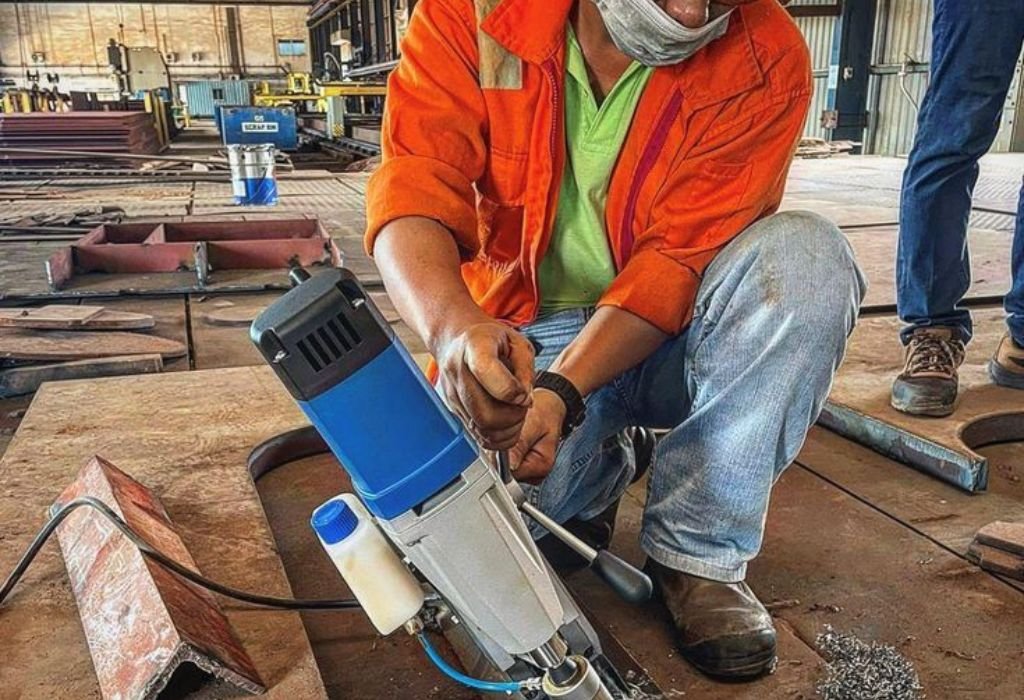
Proper maintenance ensures consistent performance and longer lifespan.
- Clean the Magnetic Base: Remove debris after every job to maintain adhesion.
- Lubricate Moving Parts: Keep feed screws and gearboxes smooth.
- Inspect Power Cords: Replace damaged cables immediately.
- Sharpen or Replace Cutters: Dull cutters strain the motor.
- Check Magnet Strength: Test adhesion before each use.
- Store Properly: Keep the machine dry and dust-free.
- Service Regularly: Schedule professional inspection annually.
Preventive care not only avoids downtime but also maintains drilling accuracy and safety.
How often should I service my mag drill?
At least once a year or after 500 hours of use.
Can rust affect performance?
Yes, rust on the base weakens magnetic grip.
How do I know cutters are dull?
Slower drilling and excessive heat are warning signs.
Should I oil the feed handles?
Yes, light oil prevents stiffness.
Is storage temperature important?
Keep between 10–40 °C and away from moisture.
Can magnets corrode?
Yes, coat with protective oil after cleaning.
Is DIY repair recommended?
Minor cleaning is fine; electrical repairs need professionals.
Future Innovations in Magnetic Drilling Technology
Magnetic drill technology continues to evolve, bringing smarter, safer, and more efficient solutions to metalworkers.
The next generation of mag drills includes brushless motors, which provide longer life with lower maintenance. Digital torque sensors now monitor drilling resistance and automatically adjust speed for optimal performance.
Manufacturers are also developing AI-assisted feed systems that detect metal thickness and apply the right pressure automatically. Cordless models are becoming lighter yet more powerful thanks to lithium-ion and solid-state battery advances, extending runtime beyond 2 hours.
Future designs may include magnet polarity sensors, real-time load feedback displays, and wireless diagnostic apps for maintenance alerts. Eco-friendly coolant recycling systems are also emerging, reducing waste on large construction sites.
These innovations will make magnetic drills even safer, smarter, and more sustainable — ensuring the tool remains a cornerstone of metal fabrication for years to come.
Will future mag drills be cordless only?
Likely not — both wired and wireless models will coexist.
What’s the biggest trend in mag drill tech?
Smart sensors and digital speed control.
Can AI really help drilling?
Yes, it optimizes pressure and protects the motor.
Will they become lighter?
Yes, carbon composites are reducing tool weight.
Are eco-friendly drills available?
Some now recycle coolant automatically.
Can future drills self-diagnose issues?
Yes, app-connected systems already exist.
Will maintenance become easier?
Definitely—smart alerts will guide users in real time.
Conclusion
A magnetic drill machine represents one of the most practical engineering innovations in modern metalworking. It bridges the gap between portability and power, allowing professionals to perform precision drilling on steel structures that were once too difficult or unsafe to handle with ordinary drills.
The combination of a magnetic base, high-torque motor, and specialized cutters transforms the process of working on beams, plates, and girders into a faster, cleaner, and safer operation.
Its importance stretches across industries—from bridge construction and shipbuilding to railway maintenance, wind-energy towers, and fabrication workshops. The ability to mount vertically or upside down without losing stability gives it an edge over any stationary drill press.
Whether powered by electricity, battery, or hydraulics, every version of the magnetic drill shares the same promise: consistency, accuracy, and reliability under pressure.
Professionals appreciate it not only for its speed and precision but also for the significant reduction in fatigue, material waste, and operational errors. With proper maintenance—keeping the base clean, lubricating parts, and using quality cutters—a mag drill can serve effectively for many years.
In short, if your work involves steel structures or any kind of heavy fabrication, a magnetic drill machine isn’t just a tool—it’s a necessity. It enables you to bring workshop-level accuracy to the job site, delivering performance that saves time, reduces cost, and ensures perfect results every single time.

I’m John F. Nicholas, the founder, lead writer, and drill enthusiast behind 101drill.com. With years of hands-on experience in power tools and DIY projects, I created this platform to share practical knowledge, expert tips, and real-world insights to help others master the art of drilling.