
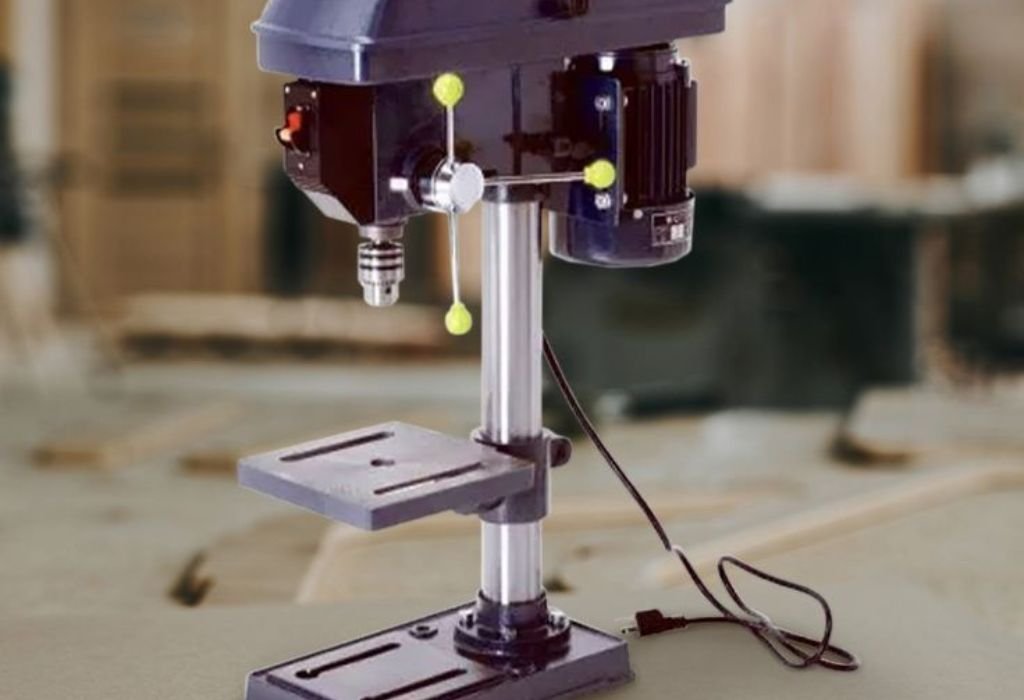
A new drill press looks impressive — shiny base, sturdy column, and a precision motor ready to work.
But then you notice the spec label: “12-inch swing.” What does that even mean? Many beginners ignore it, yet this single measurement determines what size of material your drill press can handle.
For any craftsman, understanding this term is key to buying the right machine.
A drill press swing defines the maximum width of material you can drill through the center.
According to Tool Manufacturing Insights (2024), nearly 67% of users misinterpret swing specifications when purchasing their first drill press, often leading to undersized machines and limited projects (source).
In this article, you’ll learn what drill press swing really means, how it’s measured, why it matters, and how to choose the perfect model for your workshop.
Whether you’re a hobbyist or a pro, this knowledge will prevent costly mistakes and improve your drilling precision.
What Does Drill Press Swing Mean?

Drill press swing represents twice the distance from the spindle’s center to the machine’s column. In simple terms, it’s the largest diameter workpiece that can be drilled into the center.
If you see a “12-inch drill press,” that means the distance from the spindle to the column is 6 inches — allowing you to drill into the center of a 12-inch piece. The swing defines capacity, not power.
How is drill press swing measured?
Manufacturers measure from the spindle’s center to the column, then double that distance to define swing.
Why is swing important?
It limits how far you can drill into the middle of wide materials — a small swing restricts your workspace.
Does swing affect accuracy?
Yes, larger swing models usually have sturdier frames and longer throats, improving stability and drilling precision.
Do all drills have swing measurements?
No. Swing applies to stationary drill presses, not handheld drills.
Example:
A 10-inch drill press has a 5-inch throat depth — the distance from spindle to column — allowing a 10-inch-wide workpiece to be drilled at its center.
Swing vs Throat Depth: What’s the Difference?
Swing and throat depth are related but not identical. The throat depth is the distance between the spindle and the column, while the swing is exactly twice that measurement.
For instance, if your drill press has a throat depth of 6 inches, its swing is 12 inches. These terms are often confused by beginners.
What is throat depth?
It’s the distance from the spindle’s axis to the column behind it.
How is swing calculated from throat depth?
Multiply the throat depth by two.
Does greater throat depth increase flexibility?
Yes, it lets you reach further into the center of larger workpieces.
Which is more commonly listed in product specs?
Manufacturers list swing because it sounds larger and more impressive.
Why should you care?
Because knowing both measurements helps you pick the right size drill press for your materials.
Types of Drill Presses and Their Swing Capacities
Different types of drill presses offer different swing sizes to suit various tasks.
Bench Drill Press
Compact and portable, bench models are ideal for small workshops or light-duty projects. They typically range from 8 to 12 inches in swing, perfect for woodworking, jewelry making, or small metal drilling.
Floor Drill Press
These are tall, heavy-duty machines designed for industrial and commercial use. They range from 14 to 20 inches in swing, allowing drilling into larger metal plates, wood beams, or machinery parts.
Radial Drill Press
Radial models feature an adjustable arm and can extend the drilling head outward, giving a variable swing capacity up to 30 inches or more. They’re used in fabrication and shipbuilding.
Mini Drill Press
Mini or micro models have swing capacities of under 8 inches, used for electronics, engraving, and craft precision work.
What type is best for DIY use?
A 10–12 inch bench drill press suits most home projects.
Do radial drills replace swing limits?
Yes, because the arm’s mobility lets you reposition the head beyond the fixed radius.
Are floor models stronger than bench ones?
Yes, due to their heavier motors and larger columns.
Do mini presses have less power?
Yes, they trade power for compactness.
Is swing size proportional to motor power?
Usually — larger swing presses often have more powerful motors to handle bigger tasks.
How to Choose the Right Swing Size
The correct swing depends on your typical project size and material type.
A smaller swing saves space and money but limits the work area. A larger swing increases reach and accuracy but requires more room and cost.
How large should your drill press swing be?
For small metal or wood projects, 8–10 inches is enough. For furniture or heavy fabrication, go for 15–20 inches.
Does workspace size affect your choice?
Yes, compact benches fit better in small shops, while floor models need more clearance.
Is a 12-inch drill press versatile?
Yes, it’s the most common and balanced option for both DIY and light professional use.
Can you upgrade swing later?
No, swing size is fixed by design — you’d need a new drill press.
Does swing affect speed or torque?
Indirectly — bigger presses often have better torque for larger bits.
Why Drill Press Swing Matters for Accuracy
Swing isn’t just about size — it also influences stability, precision, and control.
Larger swing models typically come with heavier bases, thicker columns, and stronger motors. These reduce vibration and ensure consistent hole alignment.
Does swing improve stability?
Yes, larger frames distribute vibration more evenly during drilling.
Is precision better with higher swing models?
Generally, yes — because of stronger structure and less deflection.
Can smaller swings still be accurate?
Yes, for light-duty work and thinner materials.
Is vibration worse in smaller presses?
Sometimes, especially if overloaded beyond their design.
Does accuracy depend only on swing?
No — it also depends on spindle runout, bit sharpness, and table rigidity.
Common Misconceptions About Drill Press Swing
Beginners often misunderstand what swing truly represents. Let’s clarify some myths.
Myth 1: Swing equals power.
Swing defines size capacity, not motor strength.
Myth 2: A 12-inch swing can drill 12-inch-thick material.
No — swing relates to width, not thickness.
Myth 3: Swing can be adjusted.
Incorrect. Swing is fixed based on machine geometry.
Myth 4: Bigger swing always means better performance.
Not always. Large presses may be overkill for small jobs.
Myth 5: Swing affects spindle travel.
No, spindle travel determines drilling depth, not swing.
Drill Press Swing and Spindle Travel — The Connection
Swing defines horizontal capacity, while spindle travel determines vertical reach. Both influence what tasks a drill press can handle.
What is spindle travel?
It’s how far the drill bit can move vertically when drilling.
Does swing affect spindle travel?
No — they are independent measurements.
Why are both important?
Together they determine the maximum workpiece size and thickness you can handle.
Can small-swing presses have long spindle travel?
Yes, especially in premium compact models.
How much spindle travel do you need?
At least 2–3 inches for woodworking and 4+ inches for metal drilling.
Maintenance Tips for Drill Press Swing Performance
Proper maintenance helps keep your drill press accurate and long-lasting.
Keep your column and spindle clean.
Dust and debris cause misalignment and wear.
Lubricate moving parts.
Regular oiling ensures smooth motion and accurate swing alignment.
Inspect belts and pulleys.
Loose belts reduce torque and cause uneven performance.
Check table alignment regularly.
An off-level table leads to angled holes, especially in larger swing models.
Avoid overloading small-swing presses.
Exceeding their capacity strains the motor and causes vibration.
Practical Examples of Swing Sizes
Understanding swing through real examples makes it easier to visualize.
| Drill Press Swing | Throat Depth | Typical Use |
| 8 inches | 4 inches | Hobby, small crafts |
| 10 inches | 5 inches | Light DIY work |
| 12 inches | 6 inches | General home workshop |
| 15 inches | 7.5 inches | Furniture, moderate metalwork |
| 20 inches | 10 inches | Heavy-duty fabrication |
What’s the best all-around swing size?
A 12-inch swing balances versatility, accuracy, and space efficiency.
Is a 10-inch swing enough for home projects?
Yes, for most light drilling tasks.
Do professionals use 20-inch models?
Yes, in industrial and commercial workshops.
Can you convert swing measurements to throat depth?
Yes — divide the swing by two.
Are larger swing presses heavier?
Always. Their weight provides added stability.
Conclusion
The swing of a drill press isn’t a random specification — it’s a key factor in determining what projects your machine can handle. It represents twice the distance from the spindle to the column, defining the maximum width you can drill into the center of your material.
For most users, a 10–12 inch swing offers the best mix of capacity and compactness. Understanding this measurement ensures you invest in a tool that matches your workspace and materials, eliminating guesswork when comparing models.
Whether you’re a hobbyist or a professional metalworker, knowing your drill press swing helps you work more efficiently, more accurately, and with total confidence.

I’m John F. Nicholas, the founder, lead writer, and drill enthusiast behind 101drill.com. With years of hands-on experience in power tools and DIY projects, I created this platform to share practical knowledge, expert tips, and real-world insights to help others master the art of drilling.